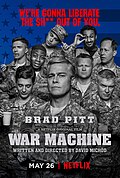
Is War Machine Based On A True Story? Unpacking the Satirical Lens
Netflix's original film, *War Machine*, released in 2017, thrust viewers into the complex and often absurd world of military leadership in Afghanistan. Starring Brad Pitt as the eccentric General Glen McMahon, the movie quickly garnered attention for its unique blend of gritty war drama and sharp, often biting, satire. But as audiences witnessed the larger-than-life characters and improbable scenarios, a burning question arose: **Is *War Machine* based on a true story?**
The unequivocal answer is yes, *War Machine* is indeed rooted in real-life events, though it takes significant artistic liberties to present a satirical commentary on modern warfare and leadership. Far from a straightforward biopic, the film draws its inspiration from a powerful non-fiction book that exposed the inner workings of America's command in Afghanistan and ultimately led to a general's spectacular downfall.
The True Story Behind the Satire: General Stanley McChrystal and *The Operators*
At the heart of *War Machine*'s narrative lies *The Operators: The Wild and Terrifying Inside Story of America's War in Afghanistan*, a groundbreaking book by the late journalist Michael Hastings. Hastings, a fearless reporter for *Rolling Stone*, was embedded with General Stanley McChrystal, the real-life inspiration for Brad Pitt's General McMahon, in 2010. His mission was to document McChrystal's efforts to turn the tide of the war in Afghanistan and garner international support for the mission.
What Hastings uncovered, however, was far more explosive than a typical war correspondent's dispatch. During his time with McChrystal and his inner circle, Hastings witnessed firsthand a cavalier disregard and open contempt for civilian leadership, particularly the Obama administration. The general's team made numerous candid, and often disparaging, remarks about key political figures, including then-President Barack Obama, Vice President Joe Biden, and other diplomatic officials.
Hastings meticulously documented these conversations and observations, publishing them in a now-infamous *Rolling Stone* article titled "The Runaway General." The article's publication sent shockwaves through Washington D.C., leading to an immediate scandal. The revelations of insubordination and disrespect from a top military commander towards his civilian superiors were deemed unacceptable. Ultimately, General Stanley McChrystal was summoned to Washington and relieved of his command by President Obama, a dramatic and highly public dismissal that underscored the delicate balance between military strategy and political oversight.
Director David Michôd (known for his critically acclaimed crime drama *Animal Kingdom*) brilliantly adapted Hastings' expose into *War Machine*, maintaining the core factual framework while transforming the human elements into compelling, often exaggerated, characters designed to highlight the inherent absurdities of modern conflict. The film doesn't merely recount events; it reinterprets them through a satirical lens, inviting viewers to critically examine the narratives of war, leadership, and media. To delve deeper into the factual accuracy versus the artistic license, you might be interested in
Fact or Satire? Unpacking War Machine's True War Story.
Brad Pitt's Portrayal: Caricature or Critical Insight?
One of the most striking elements of *War Machine* is Brad Pitt's performance as General Glen McMahon. Pitt's portrayal is anything but subtle; he embodies McMahon with an intense, almost frantic physicality, characterized by a distinct gait, exaggerated gestures, and a perpetually intense stare. While some viewers found this "overdone" initially, it quickly becomes clear that Pitt's performance is intentionally a caricature – an exaggerated representation meant to serve the film's satirical agenda.
McMahon, with his fervent belief in his own unconventional strategies and his unwavering commitment to a seemingly unwinnable war, becomes a symbol of a certain type of military leadership – one driven by a messianic complex and a disconnect from political realities. This satirical exaggeration is not limited to Pitt's character; Ben Kingsley's portrayal of Afghan President Hamid Karzai is another prime example. Karzai is depicted as almost comically detached and self-serving, further amplifying the film's critique of the complex political landscape in Afghanistan.
The brilliance of this approach lies in its ability to highlight the absurdity inherent in the real events. By pushing these characters to their extremes, Michôd encourages the audience to look beyond the surface and question the conventional narratives surrounding military and political figures. It forces us to consider how much of what we perceive as "strong leadership" might, under scrutiny, reveal elements of grandiosity or delusion. Pitt’s performance, therefore, serves not as a direct imitation of General McChrystal but as an amplified commentary on the persona, pressures, and pitfalls associated with such a high-stakes command. For a closer look at the inspirations behind Pitt's character, explore
The Real General McChrystal Behind War Machine's Satirical Glen McMahon.
Navigating the Blurry Line: Satire vs. Serious War Drama
One of the common critiques, and indeed a source of intentional artistic tension in *War Machine*, is its seemingly ambiguous tone. While characters like McMahon and Karzai are clearly satirical caricatures, many other characters, particularly the lower-ranking soldiers and the embedded journalist (played by Scoot McNairy), are portrayed with a gritty realism and earnestness typical of serious war dramas. This creates a "blurry line" for the audience, oscillating between laugh-out-loud absurdity and poignant, almost tragic, moments.
Director David Michôd deliberately plays with this tonal inconsistency. The film's voiceover, which opens with a seemingly patriotic, almost arrogant, declaration about America's pursuit of peace through war, immediately sets an ironic, questioning tone. This blend of the serious and the farcical is a hallmark of effective satire, especially when tackling subjects as grave as war. It challenges the viewer to engage actively, to discern where the film is genuinely portraying the harsh realities of conflict and where it's lampooning the pomp and circumstance that often surrounds it.
Michôd uses this blend to underscore the inherent contradictions of the Afghan War – a conflict fought with immense resources and strategic planning, yet seemingly devoid of a clear path to victory. The "absurdist war story" for our times is not merely an entertainment choice; it's a critical tool. By juxtaposing the genuine hardships of soldiers with the overblown egos of generals and politicians, *War Machine* forces a deeper reflection on the human cost of conflict and the often-detached decision-making that governs it. It’s a film that asks you to laugh, but also to reflect on the uncomfortable truths hidden beneath the humor.
The Political Undercurrents: Obama and the Afghan War Narrative
Beyond the personalities, *War Machine* also delves into the fraught political landscape surrounding the Afghan War. The film doesn't shy away from presenting an unflattering, albeit satirized, view of political figures, specifically the Obama administration. The famous scene involving President Obama in front of an airplane, where he appears more interested in a photo opportunity with General McMahon than a genuine discussion, is a pointed commentary. This moment, though dramatized, echoes the real-life tensions and the perception of a disconnect between military leadership on the ground and political leadership back home.
The film subtly suggests that political optics often overshadowed substantive strategy, implying that the administration, like the general, was caught in its own web of public image and political maneuvering. The real Michael Hastings' report, after all, gained notoriety precisely because it exposed the military's frank, unvarnished (and unauthorized) opinions on these political dynamics. By including these elements, *War Machine* serves as a critique not just of military hubris but also of the broader political apparatus that directs and funds prolonged conflicts. It encourages viewers to question the motivations and effectiveness of decisions made far from the battlefield.
Conclusion
So, **is *War Machine* based on a true story?** Absolutely. It is a powerful, albeit exaggerated, adaptation of real events, centered around the dramatic career-ending episode of General Stanley McChrystal. Director David Michôd, with Brad Pitt leading a talented cast, crafted a film that uses satire not to diminish the gravity of war, but to amplify its inherent absurdities and expose the human frailties within its command structures. By blending factual foundations with exaggerated portrayals and a deliberate tonal ambiguity, *War Machine* offers a unique and thought-provoking commentary on modern warfare, leadership, and the complex relationship between the military and civilian government. It’s a film that demands viewers to look beyond the laughs and consider the profound truths it seeks to reveal.